Accessing remote files with earthaccess
When we search for data using earthaccess we get back a list of results from NASA's Common Metadata Repository or CMR for short. These results contain all the information
we need to access the files represented by the metadata. earthaccess offers 2 access methods that operate with these results, the first method is the well known, download()
where we copy the results from their location to our local disk, if we are running the code in AWS say on a Jupyterhub the files will be copied to the local VM disk.
The other method is open(), earthaccess uses fsspec to open remote files as if they were local. open has advantages and some disadvantages that we must know before using it.
The main advantage for open() is that we don't have to download the file, we can stream it into memory however depending on how we do it we may run into network performance issues. Again, if we run the code next to the data this would be fast, if we do it locally in our laptopts it will be slow.
import earthaccess

auth = earthaccess.login()
results = earthaccess.search_data(
    short_name="ATL06",
    cloud_hosted=False,
    temporal=("2019-01", "2019-02"),
    polygon=[(-100, 40), (-110, 40), (-105, 38), (-100, 40)],
)
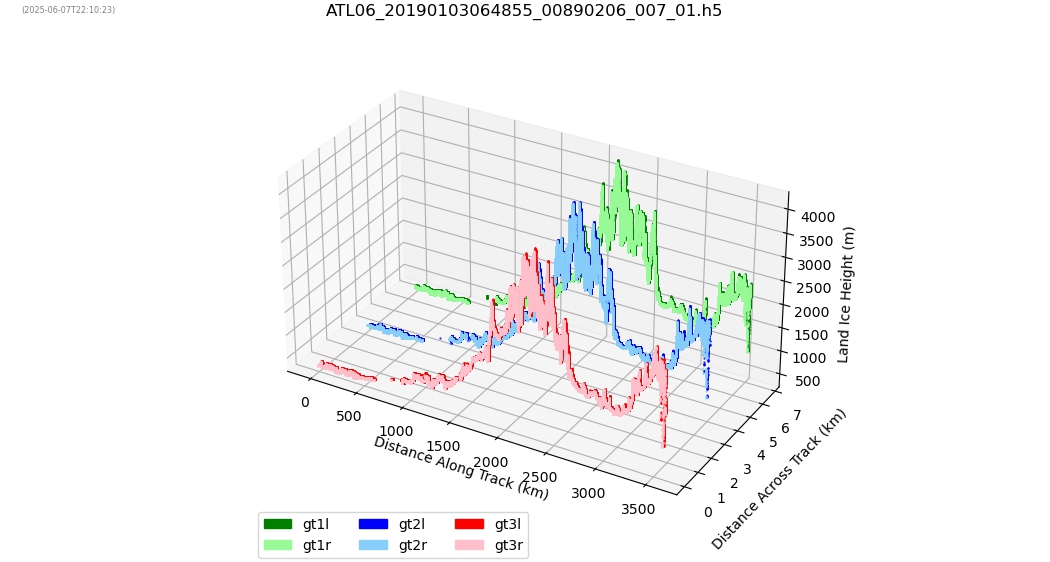
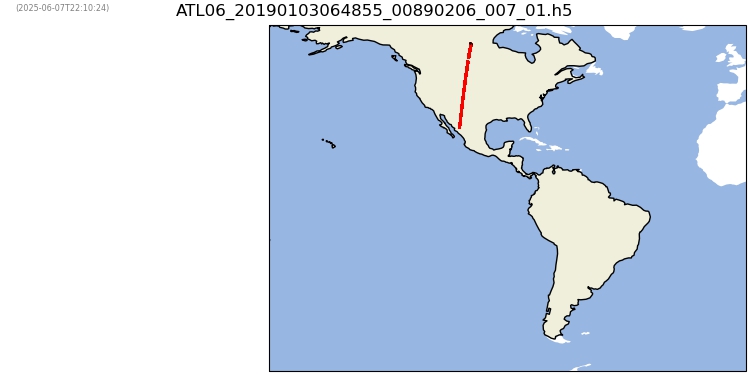
results[0]
/home/docs/checkouts/readthedocs.org/user_builds/earthaccess/checkouts/1249/earthaccess/results.py:349: FutureWarning: As of version 1.0, `DataGranule.size` will be accessed as an attribute; e.g. use `DataCollection.size` **not** `DataCollection.size()`
  self["size"] = self.size()
/home/docs/checkouts/readthedocs.org/user_builds/earthaccess/checkouts/1249/earthaccess/results.py:376: FutureWarning: As of version 1.0, `DataGranule.size` will be accessed as an attribute; e.g. use `DataCollection.size` **not** `DataCollection.size()`
  Size(MB): {self.size()}
/home/docs/checkouts/readthedocs.org/user_builds/earthaccess/checkouts/1249/earthaccess/formatters.py:40: FutureWarning: As of version 1.0, `DataGranule.size` will be accessed as an attribute; e.g. use `DataCollection.size` **not** `DataCollection.size()`
  granule_size = round(granule.size(), 2)
nsidc_url = "https://n5eil01u.ecs.nsidc.org/DP7/ATLAS/ATL06.005/2019.02.21/ATL06_20190221121851_08410203_005_01.h5"
lpcloud_url = "https://data.lpdaac.earthdatacloud.nasa.gov/lp-prod-protected/EMITL2ARFL.001/EMIT_L2A_RFL_001_20220903T163129_2224611_012/EMIT_L2A_RFL_001_20220903T163129_2224611_012.nc"

session = earthaccess.get_requests_https_session()
headers = {"Range": "bytes=0-100"}
r = session.get(lpcloud_url, headers=headers)
r
<Response [206]>
fs = earthaccess.get_fsspec_https_session()
with fs.open(lpcloud_url) as f:
    data = f.read(100)
data
b'\x89HDF\r\n\x1a\n\x00\x00\x00\x00\x00\x08\x08\x00\x04\x00\x10\x00\x00\x00\x00\x00\x00\x00\x00\x00\x00\x00\x00\x00\xff\xff\xff\xff\xff\xff\xff\xff\xd7HUn\x00\x00\x00\x00\xff\xff\xff\xff\xff\xff\xff\xff\x00\x00\x00\x00\x00\x00\x00\x00`\x00\x00\x00\x00\x00\x00\x00\x00\x00\x00\x00\x00\x00\x00\x00\x00\x00\x00\x00\x00\x00\x00\x00\x00\x00\x00\x00\x00\x00\x00\x00OHDR'
%%time

import xarray as xr

files = earthaccess.open(results[0:2])

ds = xr.open_dataset(files[0], group="/gt1r/land_ice_segments")
ds
/home/docs/checkouts/readthedocs.org/user_builds/earthaccess/checkouts/1249/earthaccess/store.py:528: FutureWarning: As of version 1.0, `DataGranule.size` will be accessed as an attribute; e.g. use `DataCollection.size` **not** `DataCollection.size()`
  total_size = round(sum([granule.size() for granule in granules]) / 1024, 2)
CPU times: user 1.4 s, sys: 173 ms, total: 1.57 s
Wall time: 10.3 s
<xarray.Dataset> Size: 7MB
Dimensions:                (delta_time: 153460)
Coordinates:
  * delta_time             (delta_time) datetime64[ns] 1MB 2019-01-03T06:49:0...
    latitude               (delta_time) float64 1MB ...
    longitude              (delta_time) float64 1MB ...
Data variables:
    atl06_quality_summary  (delta_time) int8 153kB ...
    fpb_warning_flag       (delta_time) int8 153kB ...
    h_li                   (delta_time) float32 614kB ...
    h_li_sigma             (delta_time) float32 614kB ...
    segment_id             (delta_time) float64 1MB ...
    sigma_geo_h            (delta_time) float32 614kB ...
Attributes:
    data_rate:    Data within this group are sparse.  Data values are provide...
    description:  The land_ice_height group contains the primary set of deriv...